

8 October 2025: HSC makes progress on HNEC board and approves UNSMIL roadmap
This week we look at the latest progress on Libya's political roadmap, as well as the situation in Tripoli and Dabaiba's official appointment of Suleiman as NOC chairman.

Dear Libya Analysis LLC Newsletter subscribers,
Each week, we will continue to share for free our traditional newsletter content (one article from our Weekly Report on Libya and its overall table of contents, plus teasers and info on our other products) via Substack.
In addition, readers interested in accessing additional Libya content can subscribe to the Premium (pay for) version of the Substack which gives access to two additional subscriber-only Libya articles per week, drawn from our Weekly Report. These articles will cover key developments and analysis from that week, whether in the political, economic, security or energy sectors. The premium subscription also gives access to our premium archives.
We also have a weekly Substack for our non-profit sister project the Libya Security Monitor (LSM) which you can access here.
HSC makes progress on HNEC board and approves UNSMIL roadmap but HoR 2nd Speaker rejects the process and Haftar calls for a local-led roadmap
Incident: Although there has been some progress this week towards agreement between the House of Representatives (HoR) and the High State Council (HSC) on a new board for the High National Elections Commission (HNEC), disagreements remain and nothing has yet been agreed or approved.
On 4 October, the committees recently appointed by the HoR and the HSC to agree on a new board for HNEC met in Tripoli to discuss finalising the mechanisms to complete these appointments. They had met for the first time the week before in Benghazi and had agreed to appoint a new HNEC board by 7 October. HSC head Muhammed Takala also met with the two committees, stressing the importance of completing this step.
According to Amna al-Mahjoub, a member of the HSC Committee on Sovereign Positions, the HSC is planning to hold a vote to select one candidate from a list of seven nominees for the HNEC presidency before forwarding the name to the HoR for approval. Al-Mahjoub noted that the mechanism for appointing sovereign position holders remains unclear, even within the committee itself.
On 6 October, the HSC held an official session chaired by HSC head Muhammed Takala focusing on reviewing the findings of the HSC’s Roadmap Evaluation Committee. After extensive discussion, the HSC decided to adopt the committee’s report on the roadmap. 47 out of 60 members in attendance voted to adopt the report which will be submitted to UNSMIL which will then in turn submit it to the UNSC for adoption in the roadmap. The sovereign positions file was also discussed, with the HSC deciding ‘to work on completing this file in accordance with the agreement reached between the two committees.’
Later the same day, the HoR Second Deputy Speaker Misbah Douma issued an official statement in which he said that ‘changing sovereign positions and executive authority may only take place within a single, integrated package submitted by the HSC to the HoR for adjudication in a special official session, in accordance with the provisions of the Libya Political Agreement (LPA).’ He noted that the 2020 Bouznika Agreement on Sovereign Positions ‘has been clearly violated through the appointment of individuals contrary to what was agreed upon.’
He went on to add that the Bouznika Agreement was never officially signed or ratified, making it ‘non-binding and unreliable as a legal reference for any action.’ As such, Douma argues that Article 15 of the LPA should apply, meaning the HoR appoints the heads of sovereign institutions, with consultation from the HSC, while the HoR has the exclusive authority to appoint the deputies and members of these institutions. Based on this, he said ‘we categorically reject the fragmentation of the sovereign positions file or its passage under any pretext.’
It is clear that many Libyan status quo actors remain unsatisfied with the UNSMIL roadmap, despite paying lip service to it, with actors promoting their own versions of progress.
On 3 October, Libyan National Army (LNA) Commander Khalifa Haftar held a meeting with sheikhs and notables of the tribes of the Eastern, Central and Southeastern regions at the new ‘Khalifa Haftar Military City’ near Benghazi. Government of National Stability (GNS) PM Osama Hammad and LNA Chief of Staff Khaled Haftar also attended. According to the LNA, the tribal representatives affirmed their continued support for the LNA and for Haftar, while he praised the significant role of tribes in fostering national reconciliation, emphasizing his support for all efforts for the benefit of the country and unity.
In a speech, Haftar called on Libyans to draw up a roadmap that stems from within and is based on local legitimacy, rejecting what he described as any solutions imposed from abroad under the guise of international settlements. Haftar said that ‘a map woven across borders cannot build a fully sovereign, free state.’
Government of National Unity (GNU) PM Abdul Hameed Dabaiba held a meeting with Presidential Council (PC) head Muhammed al-Menfi this week in which they discussed the implementation of the security plans and agreements for Tripoli. Dabaiba also met with HSC head Takala discussing enhancing cooperation between the government and the council including joint measures and procedures to ensure political stability and coordinate efforts. In a meeting between al-Menfi and Takala, the two men discussed the four-part political vision al-Menfi presented to the UN General Assembly in late September as well as ways to accelerate the pace of work on unification of sovereign positions.
SRSG Hanna Tetteh is due to brief the UN Security Council on her political roadmap and the situation in Libya at some point before the end of October. The UNSC is also expected to vote on a draft resolution renewing UNSMIL’s mandate ahead of its 31 October expiry. The current resolution extended UNSMIL’s mandate for three months, until 31 January 2025, with a ‘further automatic extension’ of an additional nine months, until 31 October 2025, if a new Special Representative and Head of UNSMIL was appointed by 31 January 2025 – which they were.
Comment: The HSC roadmap committee’s report reviewed a number of positive aspects of the UN roadmap, including ‘commitment to the Constitutional Declaration and its amendments, the political agreement, the adoption of the principle of elected legislative bodies as a reference for implementing the roadmap, and the gradual implementation of the roadmap’s phases.’ It also pointed to negatives, including ‘ignoring the issue of the draft constitution, failing to define its position within the resolution process, and the absence of clear mechanisms for selecting a unified government and defining its powers.’ It also noted ‘ambiguity in the concept and mechanisms of structured dialogue, and the existence of a contradiction between the gradual solution option and the ‘single package’ option.’
HSC member Naima al-Hami confirmed in televised comments after the HSC session that the HSC agreed on the need to fully renew the HNEC board of directors ‘in line with the results of the work of the Sovereign Positions Committees of the HoR and HSC, which were officially approved by the heads of both councils.’ Al-Hami said that the HSC will rely on the names previously nominated for the positions of chairman and member of the board of directors of the HNEC, without resorting to reopening the nomination process. She also noted the importance of close coordination with the HoR regarding filling the positions of Chairman of the Administrative Control Authority and Chairman of the Anti-Corruption Authority during the coming period. She added that HNEC is working to complete the process of renewing the HNEC board before the UN envoy’s next briefing to the Security Council.
The Bouznika Agreement was made in Morocco October 2020 between the HoR and HSC under which the two sides agreed mechanisms through which to appoint the heads and board of directors of key Libyan sovereign institutions (as outlined in Article 15 of the 2015 LPA), including HNEC, the ACA, the Anti-Corruption Authority, the Central Bank of Libya, the Audit Bureau, the Supreme Court and the Attorney General. However, no real progress has been made since then, with the changing of the CBL governor in 2024 agreed through other channels and mechanisms.
Ziad Dgheim, al-Menfi’s Political Advisor, said this week that al-Menfi is holding consultations and evaluating new ideas to implement his four-part political vision. This includes: 1- Restoring full national sovereignty and rejecting all forms of foreign interference. 2- A sincere and comprehensive national dialogue, held within Libya. 3- Unifying sovereign institutions, especially the security, defense, and financial institutions, according to professional mechanisms that are not subject to polarization or quotas. 4 - Ending the transitional phase through a clear constitutional basis and free and transparent elections.
Significance: As expected, the initial deadline of ten days for the HSC and HoR committees to agree on a new HNEC board (by 7 October) has passed without a board being ratified. While the HSC has made some progress on this issue, the HoR’s Second Deputy Speaker has made it clear that at least part of the HoR has no intention of following through to replace the HNEC board, let alone the rest of the roadmap. It is possible that a new HNEC board will be approved before Tetteh addresses the UNSC later this month (like 21 October), but this is far from guaranteed.
The HSC’s approval of the roadmap report is being understood as the HSC accepting Tetteh’s political roadmap for Libya, albeit with some comments and pushbacks. Similarly, although the HNEC-appointment mechanism remains unclear, the HSC appears to be trying to make progress on this issue. In part, this is likely to ensure that Tetteh is able to inform the UNSC that the HSC has been playing ball and to ensure that the HSC remains relevant. However, there are still many HSC members who do not support this position. Furthermore, approving the roadmap and HNEC board mechanism is still a long way from committing to making genuine concessions and compromises in order to resolve the outstanding issues with the electoral and constitutional framework to end the transitional period. It remains unlikely that the HSC members will agree enough to make any internal progress on the wider electoral issue in the short term, let alone to make any progress with the HoR.
Unlike the HSC, the HoR has not formally reviewed or approved the UNSMIL roadmap and is unlikely to do so anytime soon. The HoR has greater legislative authority than the HSC and is likely to be less concerned about being sidelined or pressured by the UN. Instead, it wants to retain its control over the political process and has made it clear it does not want to amend the existing electoral laws. In addition, the Haftars have made it clear they have no intention of giving up their extensive political, security and economic control over eastern Libya. As such, if Tetteh’s roadmap is to stand any chance of progressing, UNSMIL will either have to bend to some of the East’s conditions or find a way to persuade the UNSC to apply real pressure in the form of sanctions or similar punitive action. Given the latter remains unlikely, the chances of the roadmap producing a consensus-based amendment to the electoral framework remain slim.
Covered in our Premium Version:
Implementation of the Tripoli Security Agreement has stalled, but the situation remains relatively calm for now
Incident: On 1 October, PC head Muhammed al-Menfi and GNU PM Abdul Hameed Dabaiba launched the implementation of the Tripoli Security Agreement through a multi-phase plan aimed at stabilizing the capital and consolidating its security and military institutions. The plan is designed to eliminate overlapping authorities and reinforce state oversight. The first phase starts with relocating all Ministry of Defense reserve forces to outside the greater Tripoli region. The second phase foresees the withdrawal of each security agency to one single headquarters inside the capital. In the third phase, the Tripoli Security Directorate will take over responsibility for securing the whole capital.
Dabaiba officially appoints Suleiman as NOC chairman as Eni resumes offshore drilling
Incident: Last week, GNU PM Abdul Hameed Dabaiba took the decision to appoint Massoud Suleiman as the permanent Chairman of the National Oil Corporation (NOC). On 29 September, GNU PM Dabaiba officially appointed Massoud Suleiman, the acting head of the NOC, as official Chairman of its Board of Directors. However, the GNU did not formally announce or publish the decision. Rather, it was leaked online on 30 September. On 1 October, Suleiman met with the EU Ambassador to Libya Nicola Orlando who congratulated him on his official appointment.
For more...
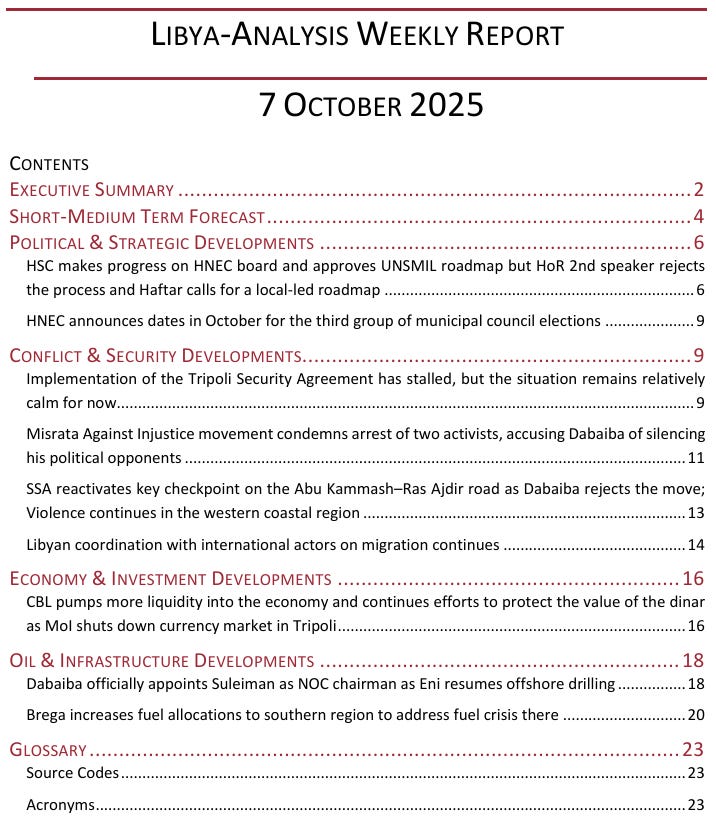
The contents page for this week’s Libya-Analysis Weekly Report is set out below:
If you are interested in subscribing to our Weekly Report and would like to receive more information about the product, please contact Rhiannon Smith, Managing Director, at Rhi@Libya-Analysis.com.
Spotlight on... Humanitarian Sector Reports
Libya-Analysis offers bespoke reports on the humanitarian sector. Our team has close links with NGOs based in Libya and Europe and can report on the latest news for clients interested in the humanitarian sector, including migration and refugees as well as access to food, fuel and cash.
For more information, please contact Rhiannon Smith, Managing Director, at Rhi@Libya-Analysis.com.
From our Blog..
On 30 September, UNDP’s Resident Representative in Libya Sophie Kemkhadze published a report titled ‘From Coastline to Climate’. The report describes Libya as a ‘land of vast opportunity’, with its...read more
To read our other blog posts, click here.
About Libya-Analysis
Libya-Analysis® helps clients understand Libya. We are a boutique consultancy with years of experience producing nuanced, evidence-based research, analysis, and forecasting on Libya. Our strategic insights are used by multinational companies, international organisations, and democratic governments to make sense of the latest political, economic, commercial, and security developments in Libya.
Keep reading with a 7-day free trial
Subscribe to Libya-Analysis to keep reading this post and get 7 days of free access to the full post archives.