

22 July 2026: Libya faces electricity crisis driven by lack of fuel as major blackout knocks out water supply and blame game heats up
This week we look at the nationwide electricity crisis and blame game, plus a flurry of interventions adding to the pollical confusion and foreign security engagement with unlikely Libyan actors.

Dear Libya Analysis LLC Newsletter subscribers,
Each week, we will continue to share for free our traditional newsletter content (one article from our Weekly Report on Libya and its overall table of contents, plus teasers and info on our other products) via Substack.
In addition, readers interested in accessing additional Libya content can subscribe to the Premium (pay for) version of the Substack which gives access to two additional subscriber-only Libya articles per week, drawn from our Weekly Report. These articles will cover key developments and analysis from that week, whether in the political, economic, security or energy sectors. The premium subscription also gives access to our premium archives.
We also have a weekly Substack for our non-profit sister project the Libya Security Monitor (LSM) which you can access here.
Libya faces electricity crisis driven by lack of fuel as major blackout knocks out water supply and blame game heats up
Incident: Load shedding (rolling blackouts) has intensified across Libya over the last few weeks, getting worse in the last few days.
Load shedding has been increasing across Libya with sources in Tripoli reporting that the frequency and duration of power outages has been increasing in recent days. The GNU has prioritised supplies to domestic consumers over commercial and industrial consumers, resulting in many factories reducing output or halting altogether.
On 14 July, the Man-Made River Authority said that at 9.00 local time, there was a total power outage at the Sarir (water) well field which resulted in the shutdown of 92 active wells at the Sarir field with a combined daily production capacity of 611,000 cubic meters of water. The outage was caused by a trip in the 66kV transformers at the West Sarir Substation (220/66kV), which supplies power to the Sarir site and wells operated by the MMR. The power was restored at 17.30 local time.
On 15 July, the Libyan Industry Union called for a meeting to discuss the negative effect of the lack of electricity allowance.
Against this backdrop, the GNU and General Electricity Company of Libya (GECOL) have been trying to bring additional capacity online to boost power production, but industry and crucial infrastructure are suffering.
On 14 July, the GNU announced that the first unit at the new South Tripoli gas-fired power station is about to enter service with a capacity of 320 megawatts.
On 15 July, the General Electricity Company of Libya (GECOL) announced that it had added additional new units to the grid which should add more than 600 megawatts, distributed across three stations. This includes the sixth gas unit at the Zueitina power station with a production capacity of 250 megawatts, the third gas unit at the Zawiyya power station with a capacity of 220 megawatts, and the third gas unit at the Awbari station with a capacity of 160 megawatts.
To make matters worse, at the weekend an unplanned total blackout knocked out power from Misrata to the Egyptian border, with 1,350 megawatts going offline.
In the very early hours of 18 July, a total power blackout hit areas stretching from Misrata in the west to Emsaad in the east. GECOL did not comment on the blackout, but the eastern-based Government of National Stability (GNS) Ministry of Electricity explained that the outage resulted from the loss of approximately 1,350 megawatts of generating capacity, in addition to the sudden shutdown of the Gulf of Sirte and Misrata power plants.
The GNS Ministry said the reason for the total blackout in the East was the separation of the line connecting the Misrata station and the Khoms station with a voltage of 400 kV. This caused a reversal of the power that was destined for the western grid with a load of 350 MW. The ministry confirmed that all technical teams are fully mobilized and that work is proceeding without interruption until grid stability is restored and electricity service is returned to all citizens.
This disruption caused widespread instability in the national grid, leading to power cuts in numerous areas in the east and central regions. The Man-Made River Authority said the blackout meant operations were halted at the Sarir and Tazirbu water well fields, as well as at a major water pumping station in Benghazi.
Power began to return gradually from 8.00 local time on 18 July, with power being restored to Sarir well field. By midday, power had been restored to Tazirbu as well. The authority said it had been forced to reduce water supplies to some cities and agricultural projects to maintain system stability and prevent depletion of the main transmission line. It confirmed that the supply of standard water volumes to all cities will gradually resume once all wells are operational and water levels within the reservoirs return to normal.
Authorities have responded by trying to secure additional capacity and fuel to power the grid.
On 20 July, the GNS Minister of Electricity and Renewable Energy, Awad Al-Badri, held talks with Egypt’s First Undersecretary of the Ministry of Electricity and Energy, Ahmed Mahina, and Head of the Egyptian Control Centre, Adel Al-Omari, resulting in an agreement to restore electricity supply through the Libyan-Egyptian interconnection lines.
Egypt will supply an initial capacity of 70 megawatts, with the Libyan authorities reportedly agreeing to pay around $100 million in overdue electricity import bills accumulated since 2023, according to an Egyptian official speaking to the media. The official said both sides agreed on a timetable to settle the remaining $41 million before the end of 2026, out of a total debt of $141 million, ensuring continued electricity flows and a gradual increase in exported power.
On 20 July, Brega Petroleum Marketing Company said it has increased the fuel allocations for Western Tripoli Power Station from 80 million litres to 110 million litres during the month of July. It said the Zawiyya depot continues to pump diesel fuel via the 16-inch pipeline to supply the South Tripoli power plant. Simultaneously, the Zawiyya depot is receiving 4 million litres of diesel produced by the Zawiyya Oil Refining Company; this volume has been directed to support the West Tripoli, Zawiya Combined-Cycle, Ruwais, Western Mountain, and Zahra power plants. In the Eastern Region, the unloading of the tanker ZEFIREA continues at the Port of Tubruq, with diesel fuel intended to meet the needs of power plants—foremost among them the Tubruq Power Plant—as well as to supply land-based stations.
The total blackout has also triggered a blame game over the cause of the outage and the intensifying load shedding.
During the televised GNU cabinet meeting on 18 July, GNU PM Dabaiba showed clear anger at the situation, calling for those running GECOL to face serious charges. He said that ‘The electricity sector was running smoothly until this director arrived and took us back to square one. The management of the electricity sector is incompetent and disastrous; they must face serious charges. How did we go from producing 10,000 megawatts to facing blackouts again?’
He warned the country is facing an electricity disaster, with the state spending ‘astronomical sums’ to maintain electricity production, yet ‘we find ourselves back at square one.’ He called for everyone involved to be put on trial and for an investigative committee to be formed to understand how the electricity situation reached this point. He noted that he and his government had boasted to Libyans that outages were a thing of the past, ‘only for some incompetent person to come along and drag us back to square one!’
On 19 July, GECOL responded to Dabaiba’s attack through various unofficial briefings and leaks to media. It shared copies of letters from early June (as we covered in our reporting at the time) in which it warned Dabaiba and the Attorney General that 1,000 megawatts of power generation have been lost due to fuel and gas shortages, specifically highlighting the drop in gas supply from Wafa field. It said it had formally requested a temporary halt to gas exports to Italy to meet the needs of the Libyan people, but that its request was completely ignored. It said it had called for urgent action before network stability was compromised – which has now happened.
GECOL also briefed that the recent clashes in Zawiyya damaged the Zawiyya power plant, resulting in a loss of approximately 700 megawatts of generation capacity. It briefed that engineers from American company GE, who were assigned to the plant, fled the country following the Zawiyya incident, stressing their security is the government’s responsibility, which it failed to uphold. It claimed the government chose to remain silent on the matter in order not to scare off other foreign companies in the country.
Comment: Power shortages and rolling blackouts are nothing new in Libya and have been a problem since the Qadhafi era due to ageing, frequently damaged infrastructure, lack of capacity within the grid and wider mismanagement and lack of investment. The problem is especially acute in summer when usage rises due to the heat.
When Dabaiba came to power in 2021, one of his main focuses under the ‘Return to Life’ programme was to significantly expand the capacity of the electricity grid and upgrade facilities. The GNU had been relatively successful with this push, with new power stations such as Tripoli South nearing completion and new units at other power stations being brought online. It has been helped by relatively stable oil production and a stronger investment environment (in relative terms) over the last few years. As such, to be faced once more with significant black outs, with large swathes of the country regularly losing power for hours at a time, is a major step backwards.
As we previously reported, on 4 June, the General Manager of GECOL Abdullah Hamouda addressed an urgent letter to PM Dabaiba, the Attorney General and the head of the Administrative Control Authority (ACA) demanding the necessary fuel to operate its power plants. The letter informed them that the operational situation at power plants ‘has reached a very critical stage as a result of the continued severe shortages in the supply of natural gas and light and heavy fuel oil’. It said this has caused the loss of more than 1000 megawatts of available production capacity. It warned that continued delays in providing the necessary fuel to power stations will lead to a widening deficit gap and increase load shedding hours across the country, with a risk of partial or total blackouts of the grid especially given the increased loads during the summer.
In response, the GNU formed an emergency committee to identify the causes of electricity outages, assess the needs of the power sector, and develop solutions aimed at improving grid performance and ensuring a fair distribution of load shedding across different regions. The GNU also directed GECOL to prepare a comprehensive technical and operational plan for regulating electricity loads during peak periods. Since then, GNU Minister of State for Prime Minister and Cabinet Affairs, Muhammed Ben Ghalbon has held meetings with Hamouda to follow up on the situation and called on the NOC and GECOL leadership to take taking urgent measures to rationalize the consumption of subsidized fuel. He highlighted the increasing reliance of industrial and service facilities, on private generators to meet their energy needs. This has led to an unprecedented surge in demand for subsidized diesel fuel, creating additional pressure on the supply system
As for the NOC, it has sought to tackle issues around gas supplies, which have declined due to systemic underinvestment, infrastructure degradation, and frequent conflicts. Unlike crude oil, which can bounce back quickly, gas production requires continuous maintenance and sustained capital funding. While there are major gas projects in the pipeline, such as Mellitah’s ‘Structures A and E’ offshore project funded by Eni, progress and funding is slow. On 21 June, Mellitah Oil & Gas successfully implemented an innovative natural gas feed-in process, known as ‘reverse feed,’ from the Mellitah Industrial Complex to the Ruwais power plant in the Nafousa Mountains. This enabled GECOL to immediately shut down the diesel-powered turbines and switch to natural gas-powered turbines with a production capacity of up to 100 megawatts in the first phase. This project aims to compensate for the shortfall in gas supplies from the Wafa field.
The shortages of gas have meant power stations are increasingly reliant on heavy fuel to run them. As with so many issues in Libya, the acceleration and expansion of fuel smuggling is a major driver of the shortages of heavy oil and diesel to operate power stations. With vast quantities of fuel diverted away from domestic, industrial and institutional consumers, including GECOL and the MMRA (or being diverted from within GECOL according to the UN Panel of Experts), into smuggling networks, there is not enough fuel to keep the power stations running. It is telling that these shortages come as Libya is importing more fuel than ever – May saw the highest volume of fuel ever imported to the country in one month.
GECOL’s revelation about Zawiyya power plant not being at full capacity due to clashes presumably refers to the major clashes on 8 May this year which resulted in damage to the Zawiyya refinery and to the power plant, causing light‑fuel leaks from three tanks at the Zawiyya power plant. Furthermore, Zawiyya has been plagued by worsening inter-militia violence and killings, creating a very insecure environment in the city which contains the country’s largest functioning refinery and a major power plant. The GNU has done nothing to intervene in the spiralling violence, leaving the city to self-destruct and its residents to suffer and die at the hands of militias and criminals.
Egypt and eastern Libya reopened talks in January over the electricity interconnection line, with plans to expand the capacity from 150 MW to 2 GW. Egypt imported approximately 33,000 barrels per day of Libyan crude in April 2026, following imports of 57,000 bpd in February. The purchases marked Egypt’s first imports of Libyan crude since 2019.
Significance: The electricity crisis that GECOL warned about six weeks ago has materialised. It seems the sudden total blackout was caused by technical issues stemming from wider instability within the grid, which in turn is due to a lack of production capacity due to a lack of fuel to run the power stations. The blame game indicates that those in power are seeking to distance themselves from the crisis. Some actions are likely to be taken by Tripoli and Benghazi in the immediate-short term to improve fuel supply to power stations, with the supply from Egypt helping to boost electricity slightly in the East. In addition, South Tripoli may finally be brought partially online. However, the sweeping reforms needed to meaningfully secure fuel supplies, boost gas production and physically secure power stations (such as for Zawiyya power station) are unlikely to materialise anytime soon. As a result, Libya can expect to experience continued load shedding and more major outages due to grid instability.
The disruption to water infrastructure as a result of the power cuts is a major concern. If the water fields keep going offline, water distribution to the rest of the country is likely to be negatively impacted and there are likely to be water shortages across the country impacting normal citizens as well as industry and agriculture.
Dabaiba’s outburst against GECOL may have been driven by real anger at the situation, given one of the few success stories of his rule had been the improvements to the electricity supply, with far fewer blackouts in recent years. At the same time, he would have been aware that a crisis was brewing and that the main cause was a lack of natural gas and fuel. Although Dabaiba may have been genuinely angry that fuel smuggling has meant there are severe fuel shortages for power stations, it is his deal with the Haftars since 2022 which has facilitated and accelerated the fuel smuggling. As such, the anger is also likely to have been a necessary protection measure designed to shift the blame entirely onto GECOL. It is unclear whether Dabaiba has any levers he could or would pull in the short term to address the fuel issue given his limited power and wiggle room at present.
While the decline in gas production is primarily a product of Libya’s political, economic and security instability over the last decade and a half, rather than being solely a recent issue, Dabaiba has sought to secure major gas production projects with international partners, notably Italy’s Eni. The failure of these projects so far to reach the production stage is largely due to investor wariness over the ongoing instability in the country and the complicated economic landscape. Concerted efforts to push these ahead would help in the medium term, but there will not be additional gas production in time to cover the summer peak.
Covered in our Premium Version:
As Boulos’ talks lose some intensity, Dabaiba and Saleh set out their own political visions while several alternative political initiatives are launched
Incident: Government of National Unity (GNU) PM Abdul Hameed Dabaiba laid out his political position during a televised cabinet meeting this week, stressing any decision would involve the Libyan people. On 18 July, the GNU cabinet held its fourth regular cabinet meeting of 2026 in Zliten. In his speech, PM Dabaiba announced his intention to address the Libyan people in the coming period, stating that he would present in detail the various local and international initiatives under consideration, as well as his vision for ending the division and holding elections. Dabaiba affirmed that he would not make or impose any decision concerning the country’s future without the will of the Libyan people, saying that they are ‘the true source of legitimacy for any political path.’ He also announced his government’s intention to launch a broad national dialogue encompassing various political and social forces to reach a shared vision for the next phase.
Jordan’s Intelligence Director visits Tripoli while Zoubi meets Egypt’s Intelligence Director In El Alamein; Saddam meets Qatari Emir
Incident: This week, the GNU has had high-level engagement with intelligence chiefs from Jordan and Egypt, both close LNA allies. On 15 July, Prime Minister Abdul Hameed Dabaiba received Major General Ahmad Husni, the Director of Jordan’s General Intelligence Directorate. During the visit, the discussions between the two officials focused on strengthening bilateral relations, reviewing regional developments, and consulting on various issues of mutual interest to enhance coordination and cooperation between Libya and Jordan. On 16 July, Minister of Interior Emad Trabelsi met in Tripoli with Husni to discuss strengthening joint security cooperation between Libya and Jordan.
For more...
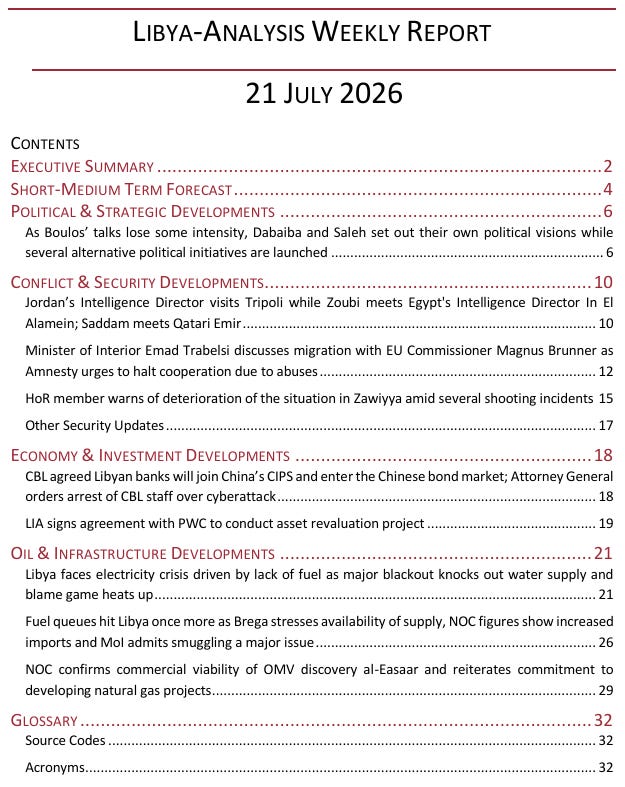
The contents page for this week’s Libya-Analysis Weekly Report is set out below:
If you are interested in subscribing to our Weekly Report and would like to receive more information about the product, please contact Rhiannon Smith, Managing Director, at Rhi@Libya-Analysis.com.
Spotlight on... Searchable Incident, Infrastructure, and Stakeholder Database
This is a unique searchable reference platform that gives users access to our extensive archives of incident, infrastructure and stakeholder mapping data on Libya. Users can search through an archive of thousands of political, security, economic, and oil and gas incidents in Libya from the last four years, which are updated weekly, and easily navigate to information about the location and actors involved. The platform geolocates and provides detailed information about all of Libya’s critical infrastructure - including oilfields, ports, pipelines and refineries - as well as providing information on key political, economic and security actors, including who controls what infrastructure. This product allows offers commercial, governmental and non-governmental organisations a unique tool to understand current developments in Libya as well as delving into detailed insights about events, locations, and actors of interest in the last four years. As such, it is used by both established clients in the Libya space and new entrants to inform their strategic and operational decision-making.
For more information, please contact Rhiannon Smith, Managing Director, at Rhi@Libya-Analysis.com.
From our Blog..
On 20 July, Chatham House published an analysis by Senior Research Fellow Tim Eaton, titled ‘Why US plans for power-sharing in Libya will not work’. Looking at recent efforts by...read more
To read our other blog posts, click here.
About Libya-Analysis
Libya-Analysis® helps clients understand Libya. We are a boutique consultancy with years of experience producing nuanced, evidence-based research, analysis, and forecasting on Libya. Our strategic insights are used by multinational companies, international organisations, and democratic governments to make sense of the latest political, economic, commercial, and security developments in Libya.
Keep reading with a 7-day free trial
Subscribe to Libya-Analysis to keep reading this post and get 7 days of free access to the full post archives.