

13 May 2026: Heavy fighting between rival militias results in several dead and injured, forces Zawiyya refinery shutdown for two days
This week we look at the latest clashes in Zawiyya, plus a meeting between Dabaiba and Meloni as well as the NOC moving ahead on its Bouri project and taking full control of Ras Lanuf refinery.

Dear Libya Analysis LLC Newsletter subscribers,
Each week, we will continue to share for free our traditional newsletter content (one article from our Weekly Report on Libya and its overall table of contents, plus teasers and info on our other products) via Substack.
In addition, readers interested in accessing additional Libya content can subscribe to the Premium (pay for) version of the Substack which gives access to two additional subscriber-only Libya articles per week, drawn from our Weekly Report. These articles will cover key developments and analysis from that week, whether in the political, economic, security or energy sectors. The premium subscription also gives access to our premium archives.
We also have a weekly Substack for our non-profit sister project the Libya Security Monitor (LSM) which you can access here.
Heavy fighting between rival militias results in several dead and injured, forces Zawiyya refinery shutdown for two days; ‘Suicide drones’ deployed
Incident: Heavy fighting erupted between rival militias in Zawiyya last week after the Zawiyya Security Directorate launched a ‘joint security campaign’ against criminal groups and wanted individuals in Zawiyya.
On 5 May in the evening, there were armed clashes between militias loyal to Muhammed Bahroun aka al-Far and the Salem al-Latif armed group in the area of al-Maqouz in Zawiyya.
On 7 May, the Zawiyya Branch of the Counter Security Threats Agency, which is loyal to al-Far, and the Shuhada al-Nasr Brigade, led by Muhammad Kashlaf aka al-Qasseb, mobilized their troops.
On 8 May in the morning, the Zawiyya Security Directorate released a statement announcing the beginning of a ‘joint security campaign’, authorized by the Attorney General, to raid and arrest criminal groups, wanted individuals, and anyone involved in threats to public safety. The campaign targets those committing major crimes including murder, kidnapping, extortion, drug trafficking, human smuggling, weapons trafficking, and attacks on property and security forces. The Security Directorate stated that the goal was to re‑establish state authority, end lawlessness, and cut off sources of crime, stressing zero tolerance for anyone obstructing the operation.
Later in the morning, the situation escalated. Heavy fighting broke out on the Refinery Road and in the vicinity of the Zawiyya refinery between the ‘joint security forces’ led by al-Far on one side, including the Counter Security Threats Agency and the First Support Force, and the Petroleum Facilities Guard (PFG) on the other, supported by the Shuhada al-Nasr Brigade, al-Latif and the al-Kabwat. Mortars and artillery were employed. Several heavy shells struck parts of the Zawiyya refinery and residential areas of the refinery.
The fighting subsequently spread to several other areas of Zawiyya, including to Harsha and Sabria in the western part of Zawiyya.
In the course of the fighting, al-Qasseb’s militias used a larger number of (probably improvised) one-way attack drones (‘suicide drones’) with devastating effect.
Zawiyya refinery was damaged during the fighting and subsequently closed for two days.
At around 11am local time, the Zawiyya Oil Refining Company (which operates the refinery) said it was concerned and fearful after armed clashes and exchanges of fire erupted near the complex in the early hours of 8 May and the situation escalated rapidly. It said numerous heavy shells had landed in various locations within the company, reaching operational areas. This necessitated the immediate and emergency shutdown of the refinery.
At about noon, the National Oil Corporation (NOC) warned that the escalating armed clashes had drastically increased the risks to Zawiyya refinery one of the country’s most sensitive energy facilities, and called for immediate de‑escalation and government intervention to protect vital infrastructure. It said all workers and students from the Engineering College were safely evacuated, leaving only firefighting and emergency teams on site. Emergency measures included shutting down the refinery, the evacuation of all tankers from Zawiyya port, and deploying specialist teams from the Zawiyya, Brega, and Akakus companies to prevent environmental or operational disasters. The NOC stressed that fuel supplies to Tripoli remain normal, with contingency stocks in Misrata ready if needed. The NOC emergency committee, led by NOC Chairman Masoud Suleiman, stated that it was in continuous contact with the Government of National Unity (GNU) as the situation evolved.
The Western Region Petroleum Facilities Guard said the Zawiyya oil complex was attacked at dawn by an ‘outlaw group’ using various weapons, with shells landing inside the facility, prompting its units to respond and hold their positions. It warned it would not allow criminals to threaten national resources and accused the Defense and Interior Ministries and the Western Coast Military Zone of remaining silent as the situation deteriorated.
In the late afternoon, Brega Petroleum Marketing Company reported that aviation‑kerosene tank No. 501 was hit during the early‑morning clashes. The tank sustained two direct impacts from heavy weapons, causing its walls to tear and large quantities of kerosene to spill around the depot. Tank No.502 was struck by gunfire. Despite the ongoing fighting, maintenance and emergency teams entered the spill site in an effort to stop the leak and prevent the fuel from reaching any ignition sources.
There was local and international condemnation of the fighting and blame-shifting over responsibility for the operation.
UNSMIL condemned the clashes in Zawiyya, warning of civilian casualties caused by heavy and indiscriminate fire in populated areas and expressing alarm over reports of residential buildings near the refinery being used for military purposes. It urged an immediate halt to fighting, protection of civilians and infrastructure, stressing that continued violence risks wider destabilization and serious humanitarian and economic damage. The mission also praised local de‑escalation efforts and reaffirmed its readiness to support restoring calm.
The West Coast Military District stated it had no involvement in the current Zawiyya Security Directorate’s operation, noting there was no coordination with them and stressing that such actions require careful planning and high‑level oversight to protect civilians and property. It rejected any involvement in any actions that could be interpreted as score‑settling and reaffirmed its commitment to stability and the rule of law.
The Zawiyya Security Directorate, however, insisted the campaign is fully legal, backed by warrants from the Attorney General.
Units from the 52nd Infantry Brigade of the Libyan Army, commanded by Mahmoud Bin Rajab, entered the area surrounding the Zawiyya oil refinery in an attempt to halt the clashes and to separate the belligerent parties.
In the early evening on 8 May, Zawiyya’s Council of Elders brokered a ceasefire after contacting both sides and securing the involvement of local military commanders.
Council leaders al‑Taher al‑Ghweil and Hussein al‑Maghribi said the truce resulted from coordinated mediation by the town’s elders, with plans for further outreach in the coming days to reduce tensions and prevent renewed fighting.
The National Institution for Human Rights in Libya (NIHRL) condemned the fighting and reported that the clashes resulted in three civilian deaths and nine injured civilians, alongside extensive damage to public and private property such as parts of the Zawiyya Oil Refinery and its storage tanks. Local sources report that the armed clashes have left at least ten militia fighters killed and twenty injured.
On 10 May, there was manoeuvring of militias and some tensions between the militias of al-Far on one side and al-Latif and al-Qasseb militias on the other side in Sabria and Harsha in western Zawiyya.
Operations at the Zawiyya fuel depot resumed the day after the fighting and the refinery reopened two days afterwards. The power station was also impacted.
On 9 May, the Brega Petroleum Marketing Company announced the resumption of operations at the Zawiyya fuel depot.
The General Electricity Company of Libya (GECOL) said clashes in Zawiyya caused light‑fuel leaks from three tanks at the Zawiyya power plant, though teams quickly contained and repaired the damage. The fighting also disabled part of the fire‑suppression system and struck the high‑pressure pump serving the first steam unit. The first gas turbine unit returned to service on 9 May after being shut down the day before when water from the fire extinguishers leaked onto the cooling motors.
On 10 May, the Zawiyya Oil Refining Company announced at 10.15 local time that all facilities had returned to normal operation after security conditions around the refinery stabilized. It said that in addition to restarting all operations and reactivating maritime traffic, the company would establish a mechanism for compensating employees for damage to personal property (such as vehicles) due to the shelling and would begin any necessary repair works on the refinery itself.
Comment: The Zawiyya refinery is the country’s largest operational refinery, with a capacity of about 120,000 barrels per day. It is connected to the Sharara oilfield, which can produce about 300,000 bpd. The refinery has long been at the heart of fuel smuggling networks in Zawiyya and the western coastal region. Control over the refinery provides significant economic opportunity and political leverage, with the militia groups controlling the complex able to smuggle fuel and threaten to shut down the refinery in order to extract concessions from Tripoli, although such threats have been infrequent in recent years.
Since the 2011 revolution the refinery in Zawiyya has been controlled by the Awlad Abu Hmeira, one of the most important tribes in Zawiyya, via the Shuhada al-Nasr Brigade (one of the most powerful militias in Zawiyya) and the local Petroleum Facility Guard (‘Al-Zawiya Support Unit for the Petroleum Facilities Guard – West’). Although there have been several attempts in the past by rival groups to take over the refinery, these have never truly been successful, with the Awlad Abu Hmeira remaining de-facto in charge even if formal control changed. The most recent example of this was the April 2025 take-over of the refinery by the West Coast Military District.
Muhammad Kashlaf aka al-Qasseb is the commander of the Shuhada al-Nasr Brigade and the head of the Zawiyya PFG. He is deeply involved in human trafficking, fuel smuggling and other crimes like kidnapping and murder. Since 2018, he has been sanctioned by the UN Security Council, the U.S. Department of Treasury, the European Union and UK. Al-Qasseb is a main rival to al-Far.
Salem al-Latif is a local Zawiyya militia leader who is backed by the al-Kabwat. The al-Kabwat militia is affiliated with the 103rd Infantry Battalion aka Al-Sila’a which is led by Othman al-Lahab. He belongs, like the bulk of his men, to the al-Khadrawi clan of the Awlad al-Saqr tribe. Allegedly, the al-Kabwat are deeply involved in fuel smuggling and human trafficking, operating almost along the entire western coast between Tripoli and Zuwara. Previously, the al-Kabwat were allied with al-Far, but they are now fierce opponents.
Muhammed Bahroun aka al-Far, deputy commander of the Counter Security Threats Agency and commander of the First Support Force, is one of Zawiyya’s most powerful militia leaders. Since 2012, Al-Far has had a track record of criminality and bullying in the city of Zawiyya, including acts of reported kidnapping, murder, liquidation, looting of money and property, trade in weapons and ammunition, in addition to smuggling fuel and trafficking in illegal immigration.
Significance: The renewed heavy fighting in Zawiyya has exposed the deep collapse of security and state authority in western Libya, the dominance of militias over state institutions and the absence of capable state-controlled security forces. In this case, it seems that armed groups affiliated with al-Far sought to move against Salem al-Latif’s militia, framing it as a legitimate operation to tackle criminal groups and activity. Al-Qasseb then sided with al-Latif and his allies. Whether or not al-Far had any authorization from the Attorney General is unclear and largely irrelevant insofar as most of Zawiyya’s militias are involved in criminal activity, so any campaign is primarily about securing power and territory and settling scores. It is also unclear whether the refinery was a target for al-Far or whether it was collateral damage. What is clear, however, is that inter-militia tensions within Zawiyya are very likely to remain high, with renewed clashes likely in the coming period.
Zawiyya’s strategic location in western Libya, with Tripolitania’s only refinery, an oil terminal, migrant embarkation sites and several competing militia networks seeking control over smuggling routes and economic hubs, have made it into a lawless city. Authorities in Tripoli are entirely unable to impose law and order. While all the involved armed groups are affiliated either with the MoD or the MoI and receive funding from the state’s budget, the GNU has no authority over them. As a result, the GNU is not in a position to be able to provide security to the citizens of Zawiyya or the wider region, nor to hold the militias accountable for their actions.
The first-time use of a large number of suicide drones represents an unprecedented escalation in local urban fighting in Libya. Their appearance raises serious questions about weapons supply chains and manufacturing capabilities and highlights the widening gap between the state’s nominal authority and the reality of heavily armed militias with advanced capabilities.
The incident once again highlights the vulnerability of Libya’s energy infrastructure to recurring security tensions and armed confrontations. Repeated disruptions affecting oil facilities could place additional pressure on domestic fuel supplies and further complicate the country’s economic situation. The explosive situation in Zawiyya is likely to discourage international oil companies from significant investments in western Libya as developments are very difficult to predict. Any disruptions to Zawiyya refinery and oil terminal lasting more than a few days would also have a knock-on effect on production from the linked Sharara oilfield. Under the current conditions, further disruptions to the refinery’s operations due to violence are likely in the short term.
Covered in our Premium Version:
Italian PM Meloni receives Dabaiba in Rome, discusses energy, economic cooperation and migration; Irini and EU prepare for MRCC in Benghazi
Incident: This week, PM Abdul Hameed Dabaiba arrived in Rome for an official visit with a senior GNU delegation, focusing on energy and economic cooperation. On 7 May at noon, PM Dabaiba was received by Italian PM Giorgia Meloni at Palazzo Chigi, the official seat of the Italian Council of Ministers and the residence of the Italian PM. During the meeting, the two prime ministers discussed ways to ‘further strengthen the already solid bilateral cooperation,’ focusing in particular on economic ties, energy‑sector investment, and migration management. Meloni also reiterated Italy’s full support for a Libyan-led political process facilitated by the United Nations to stabilize the country.
Major strategic oil projects move ahead as Bouri’s gas exploitation module is completed and NOC takes full control of Ras Lanuf Refinery
Incident: This week, Mellitah’s gas exploitation module for the Bouri offshore field was completed with a ceremony in Italy while the NOC signed an agreement re-establishing full control of Ras Lanuf refinery. On 5 May, the National Oil Corporation (NOC) announced that the Mellitah Oil & Gas Company (a joint venture between Eni and NOC) has completed the manufacturing and assembly works of the offshore gas‑processing module for the Gas Exploitation Project in the Al-Bouri field, some 170 km off the coast of Libya. The announcement followed an official ceremony in Ravenna, Italy, when the 5,200‑tonne module was shipped off to Libya.
For more...
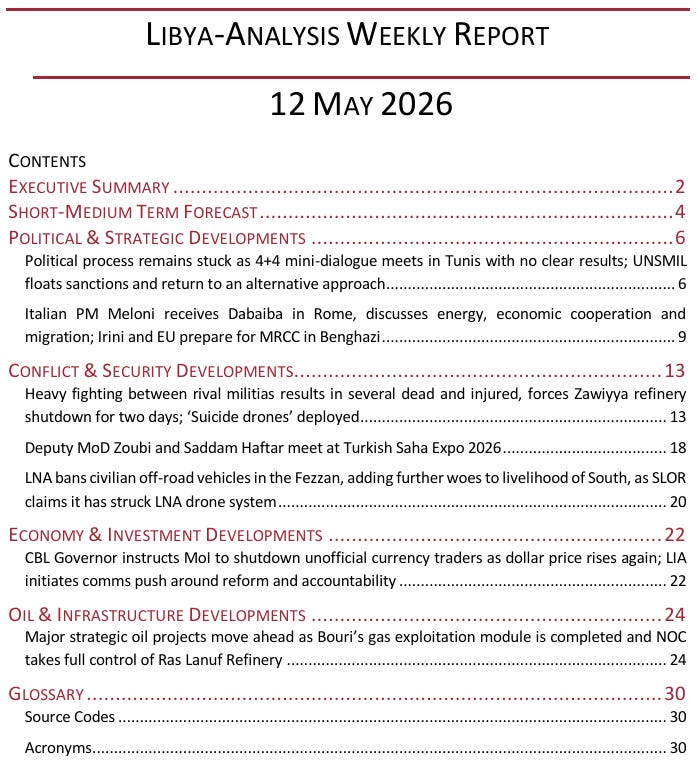
The contents page for this week’s Libya-Analysis Weekly Report is set out below:
If you are interested in subscribing to our Weekly Report and would like to receive more information about the product, please contact Rhiannon Smith, Managing Director, at Rhi@Libya-Analysis.com.
Spotlight on... Armed Actor Mapping Report
Our armed actors mapping report provides detailed profiles and stakeholder mapping on the most important armed groups currently active in Libya, including their geographic location, territorial control, leadership and main relationships. The report also comments on the social media profiles of these groups, their historical activity, how they are financed and their command-and-control relationships. In short, this report allows the reader to understand who the most important armed groups are, what they want, and where they fit into the complex nexus of political, economic and security actors in Libya.
For more information, please contact Rhiannon Smith, Managing Director, at Rhi@Libya-Analysis.com.
From our Blog..
On 6 May, Foreign Policy published an article by Nosmot Gbadamosi, titled ‘Can a U.S.-Brokered State Budget Help Unite Libya?'. Gbadamosi speaks to several analysts about the recent...read more
To read our other blog posts, click here.
About Libya-Analysis
Libya-Analysis® helps clients understand Libya. We are a boutique consultancy with years of experience producing nuanced, evidence-based research, analysis, and forecasting on Libya. Our strategic insights are used by multinational companies, international organisations, and democratic governments to make sense of the latest political, economic, commercial, and security developments in Libya.
Keep reading with a 7-day free trial
Subscribe to Libya-Analysis to keep reading this post and get 7 days of free access to the full post archives.